Pickleball tips
Coach Mo · Pickleball coach in San Jose, California
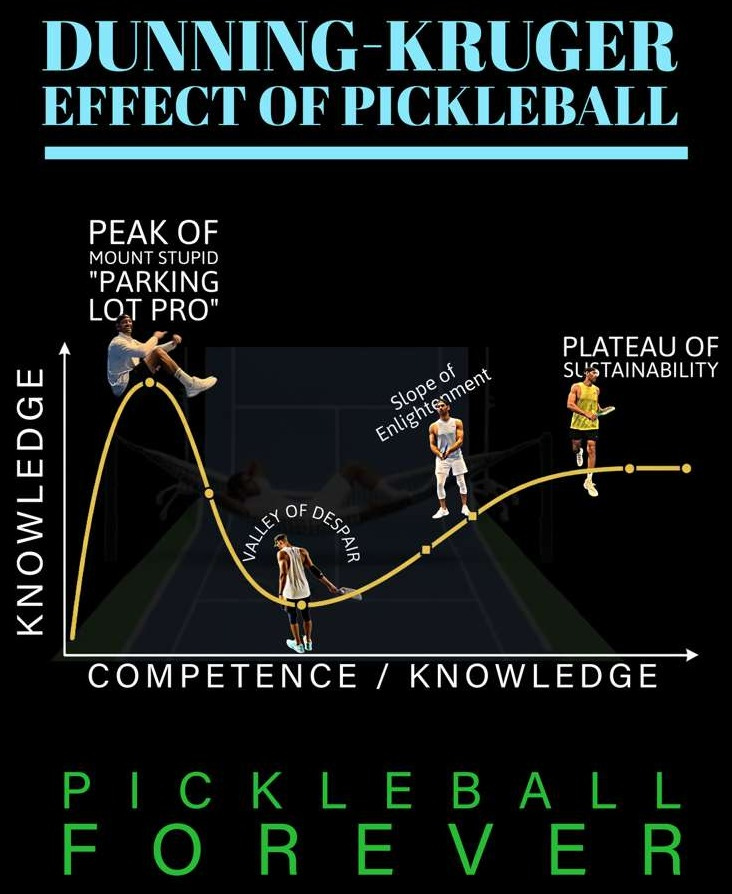
I first learned about the Dunning-Kruger Effect ("DKE") in a freshman behavioral economics class. The theory stayed buried in my subconscious for years—until I pulled a forehand wide during a transition dink last week.
My brain is a strange place; Dunning and Kruger's cognitive bias theory hasn't crossed my mind in an eternity, yet there it was, manifesting in the middle of a pickleball game.
Candidly, we should probably blame Levi for this. I had the pleasure of meeting Levi Daniel that day—a professional player and an even better man. How many pros do you know who would grind through eight games in a row with someone they just met? He's a natural leader with an insane court IQ, a purist who pushes the game forward with his how, not just his what. He was patient, and little by little, just by sheer inertia, I found myself growing, learning, and evolving.
But that evolution comes with a price: awareness.
DKE is the notion that when you know very little about something, you tend to overestimate your ability. As you gain knowledge, your confidence often craters—not because you're getting worse, but because you finally begin to understand the true complexity of the task.
On a pickleball court, this plays out in real-time. As a beginner, my confidence was sky-high because the game looked so simple. Hit ball, ball go over net.
But "Intermediate Awareness" is frustrating. The game suddenly feels infinite. You realize, among many other things, that:
• Power isn't precision. • Speed isn't strategy. • Winning against weaker players isn't mastery.
The more you learn, the more you see how much you don't know. That is the essence of the Dunning-Kruger Effect—and it can feel exactly like getting worse.
That is the Paradox of Skill: Your standards rise faster than your execution.
Your brain sees the correct shot, but your body doesn't always deliver it. Or sometimes your body is ready, but your mind hesitates. You're trying more advanced patterns, more complex resets, and more patient points.
And yes—you're still making mistakes.
But they're better mistakes. They are more informed mistakes. They are mistakes made in the pursuit of mastery, not just the scramble for survival…
You know nothing — and you know that you know nothing. This is the first day you pick up a paddle. Your confidence is low, but you're curious.
Stage 2: The Rapid Rise
You learn scoring. You learn the kitchen rule. You start winning games against other beginners.
Your confidence skyrockets. You watch YouTube videos about third-shot drops and suddenly feel like you've cracked the code. This is the most dangerous phase. Because improvement comes quickly early on, you start overvaluing what you know.
Stage 3: "Mount Stupid"
Harsh name. Not mine. Blame Dunning and Kruger. But accurate. This is when you know enough to believe you understand the game.
You talk about: • Paddle angle • Spin generation • Shake-and-bake patterns • Transition resets • Erne timing
You believe if you just "execute properly," your game will explode. You might even get better during this phase. But then something unsettling happens. You realize the mechanics you rehearsed in your driveway don't hold up under pressure. You hit the perfect third shots while drilling. Then pop it up in a real match. You're "doing everything right" — but the results aren't matching your expectations.
Cracks form.
Stage 4: The Valley of Despair
I imagine this is where most players stall. Confidence collapses. You see everything now: • Your reset isn't consistent. • Your footwork is godawful. • Your decision-making is rushed. • Your patience evaporates at 9-all.
You feel worse than when you started. You question yourself. "Was I better before I started trying to improve?" No. You're just more aware.
And this, my friends, is the paradox of skill:
Your standards rise faster than your execution.
Your brain sees the correct shot.
Your body can't always deliver it.
Or your body is ready — and your mind hesitates.
You attempt more complex patterns.
More patient points.
Higher-percentage resets.
And yes — you make mistakes.
But they're better mistakes.
They are informed mistakes.
They are mistakes made in pursuit of mastery — not survival.
If you stay in the work long enough, something will shift…I hope. Dunning and Kruger, I'm counting on you to be right. So I can count on doing things like: Not chasing flashy mechanics.
Starting to understand cause and effect.
To realize that: Margin matters more than speed.
Decision-making matters more than power.
Simplify things. Then hope the confidence returns – cautiously, that is.
Once I'm off it, I don't ever want to forget about the feeling of being atop Mount Stupid.
Humility enters the chat.
One day. I hope. It looks simple. Because it is.
Experts don't rush.
They don't over-explain.
They don't panic at 10-9.
They understand systems.
They understand probability.
They understand that improvement is nonlinear.
And here's the twist:
Someone on Mount Stupid might look at that expert and think they know more.
Because simplicity can look shallow to someone addicted to complexity (like me)
But real mastery reduces noise.
So why does confidence often dip as knowledge increases?
Because when you truly understand pickleball, you realize how much you don't know.
You understand: • Motor learning is unpredictable. • Pressure changes mechanics. • Fatigue changes timing. • Advice given mid-game rarely sticks.
You become cautious.
Not insecure — aware.
Wise players don't rush to conclusions.
They build systems.
Pickleball Forever.
Coach Mo
https://pickleballforever.substack.com/p/pickleballs-dunning-kruger-effect
About the coach
Coach Mo
Pickleball coach in San Jose, California
Booking 1:1 lessons in the San Jose / Bay Area: Rengstorff Park, Cataldi Park, Cupertino Memorial Park, and West Valley College. PPR-trained instructor with 3 years teaching beginners and intermediates — fundamentals, positioning, shot selection, movement, consistency, and match strategy, tailored to your game and goals.
Book a pickleball lesson with CoachReady to put it into practice?
Book a pickleball lesson with Coach in San Jose, California and get coaching built around your game.
Book a lesson with CoachGet Started
Contact Coach to ask about upcoming lessons and programs.
Where Coach Teaches
© 2026 Coach Mo. All rights reserved.