Pickleball tips
Coach Mo · Pickleball coach in San Jose, California
There's a unique kind of exhaustion that pickleball players know well
Not the good kind. Not the legs-heavy, shirt-soaked feeling after a long session.
I mean the strange mental fatigue after a day where you technically played fine… but somehow still drove home unsatisfied.
You got games in. Maybe even won more than you lost. Your drops were falling. Your hands felt alive. You hit a few super low margin for error shots.
And yet something about the session didn't land.
You leave feeling like the experience owed you something it never delivered.
I think a lot of players live inside that feeling without realizing what's actually causing it.
I, for certain, do. And honestly, I don't think it has much to do with pickleball.
The Invisible Contract
I used to think presence was just a focus issue.
Assumed I was just distracted. Too much phone. Too much thinking ahead. Not "locked in."
But I don't think that's the real problem.
I think the problem is demand.
I walk onto the court carrying invisible contracts with the experience before the first ball is even hit.
This session should feel productive. I should feel sharp today. My game should finally click. This should feel fun. This should feel meaningful.
None of these thoughts sound unreasonable. And I actually think that is what makes them dangerous.
Because the second a moment has a job to perform for you, you stop fully experiencing it. You start evaluating it.
You're no longer just playing pickleball. You're grading pickleball.
The Mental Audit
You can feel it happen early in a session.
A few points in, the internal commentary starts running in the background:
Why am I missing that ball? Why do I feel flat today? Am I actually getting better? Shouldn't I be playing cleaner than this by now?
Meanwhile, your body is literally doing the thing you wanted to do all day. You're moving. Competing. Laughing with friends. Playing a sport you genuinely love.
But mentally, you're somewhere else entirely — comparing the current experience against a version of it that existed only in your head. That comparison creates this low-grade dissatisfaction that follows people everywhere now, not just in sports.
We don't just want experiences anymore.
We want experiences to confirm something for us.
That we're improving. That we're progressing. That we're becoming who we think we should be.
And when a session refuses to provide that confirmation, even a good day on the court can feel strangely empty.
Why "Be Present" Rarely Works
The standard advice is always the same: "Just be present."
"Stay mindful."
"Focus on the moment."
That advice isn't wrong. It's just incomplete.
Because most people approach presence the same way they approach improvement — aggressively. They try to be present.
Which ironically becomes another demand.
Now the session isn't just supposed to feel good. It's supposed to feel mentally clear and spiritually meaningful too.
That's like trying to force yourself to fall asleep. The harder you chase it, the further away it gets.
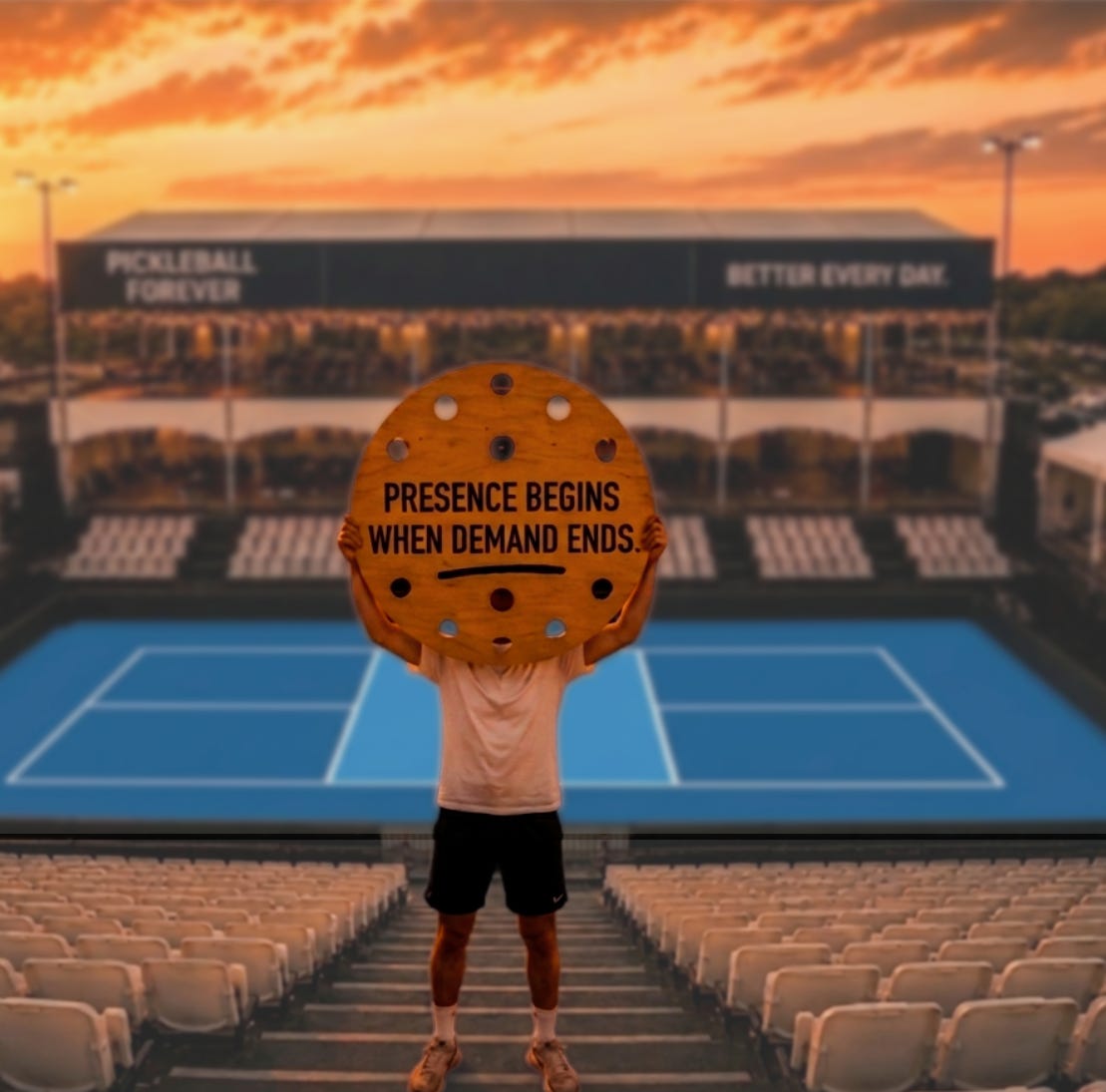
Presence isn't something you squeeze out of a moment through effort. It's what remains after you stop demanding the moment justify itself.
The Court Doesn't Owe You a Breakthrough
This was a hard realization for me.
Especially in pickleball culture, where improvement is everywhere.
DUPRs. Drills. Metrics. Content. Technique breakdowns. Slow-motion film. Tournament results. Everything is measured now.
And don't get me wrong — improvement matters. I love improvement. I'm obsessed with getting better. The entire Better Every Day concept is built around intentional growth. I'm forever grateful for some of the OG pickleball legends who took the time to get to know me, teach me, play with me, and let me model my game after them. The legends who told me how wrong I was doing things when I needed to hear it. People like Janaye Sakkas, Justin Ho, Levi Daniel, others — the best — telling me how to improve.
But there's a subtle trap hidden inside self-improvement culture:
You start treating every session like it needs to produce evidence.
Evidence that you're progressing. Evidence that the work is working. Evidence that you're becoming "better."
And when a session doesn't provide that emotional payoff, you subconsciously mark it as disappointing.
Sometimes the run is just a run.
Sometimes the court gives you awkward resets, weird net cords, ugly misses, random laughs, chaotic firefights, and one clean backhand roll that reminds you why you came in the first place.
That's enough.
Lower Demand, Higher Presence
Lowering demand on a moment does not mean becoming passive, lazy, or indifferent.
It means removing the hidden requirement that the moment must feel a certain way in order to count.
A solid lesson doesn't need to feel heroic.
A rec game doesn't need to become content.
A session with friends doesn't need to become a core memory.
A drill session doesn't need to reveal your future as a pro player.
You can still care deeply. Compete hard. Pursue growth relentlessly.
But the healthiest players — and honestly the happiest people — seem to understand something subtle:
They let the experience arrive before deciding what it means.
Presence isn't something you squeeze out of a moment through effort. It's what remains after you stop demanding the moment justify itself
What I'm working on - small things that actually help:
Before I walk onto the court, I ask myself one simple question:
What am I secretly hoping this session gives me? Maybe it's: · confidence · momentum · validation · clarity · joy · connection · escape
I just notice it. I try not to judge it. Or suppress it.
Then I mentally loosen my grip on it.
Something like: Yeah, I'd love for today to feel great. But I'm going to let the session be whatever it actually is.
That tiny separation changes everything. Because now I'm participating instead of auditing.
I stop forcing moments to perform for me.
And weirdly, that's usually when they start giving me more.
The Sessions You Actually Remember
Think about the pickleball days you remember most. A lot of them probably weren't the ones where you demanded magic from the court.
They were the accidental ones.
The random late-night rec games.
The unexpected battle against strangers.
The chaotic doubles match where everyone was laughing.
The session where your hands randomly caught fire for twenty minutes.
The post-game conversations in the parking lot.
The moments landed because you weren't squeezing them for meaning while they were happening.
You were just there. Fully there.
Pickleball Forever ♾️
I think this is part of why people fall so deeply in love with pickleball in the first place.
Not because every session is transcendent.
But because for brief moments, the scorecard disappears.
You stop managing your life for a second.
You react. Move. Laugh. Compete. Miss. Adjust. Recover.
You become absorbed instead of analytical.
And honestly, that feeling is getting rarer everywhere else.
Maybe presence doesn't begin with trying harder to "live in the moment."
Maybe it begins when you stop asking the moment to prove itself to you.
The court was never supposed to solve your life. Sometimes it's just supposed to be a court.
Pickleball Forever.
Onward,
Coach Mo
https://pickleballforever.substack.com/p/the-hidden-scorecard-we-bring-onto
About the coach
Coach Mo
Pickleball coach in San Jose, California
Booking 1:1 lessons in the San Jose / Bay Area: Rengstorff Park, Cataldi Park, Cupertino Memorial Park, and West Valley College. PPR-trained instructor with 3 years teaching beginners and intermediates — fundamentals, positioning, shot selection, movement, consistency, and match strategy, tailored to your game and goals.
Book a pickleball lesson with CoachReady to put it into practice?
Book a pickleball lesson with Coach in San Jose, California and get coaching built around your game.
Book a lesson with CoachGet Started
Contact Coach to ask about upcoming lessons and programs.
Where Coach Teaches
© 2026 Coach Mo. All rights reserved.