Pickleball Court Positioning Tips For Cary Players
Pickleball tips
Pickleball Court Positioning Tips For Cary Players
RL
Russ Lombardo · Pickleball coach in Cary, NC
If you want more wins with fewer unforced errors, master where to stand, when to move, and how to work with your partner. I’m Russ Lombardo, and here is how I teach pickleball court positioning that Cary area players can apply right away: win the kitchen line early, shrink the court for your opponents, and move as a connected team so you control the tempo.
What Are The Basics Of Pickleball Court Positioning Cary Players Should Know?
Positioning starts before the serve. Think purpose first, feet second. On serve, aim to keep the ball deep and give yourself time to advance. On return, prioritize depth and height that buy you time to reach the kitchen line with balance. From there, the match often becomes a battle for the non-volley zone. The team that gets to the kitchen together, sets their feet, and dinks with intention usually controls the point.
My core rules for Cary courts:
Serve team: place deep, then work forward in layers. Do not sprint into the transition zone blindly; earn it with a third shot drop or a controlled drive and a reset.
Return team: send the return deep crosscourt, move in behind it, and split step just before your opponent hits the third shot.
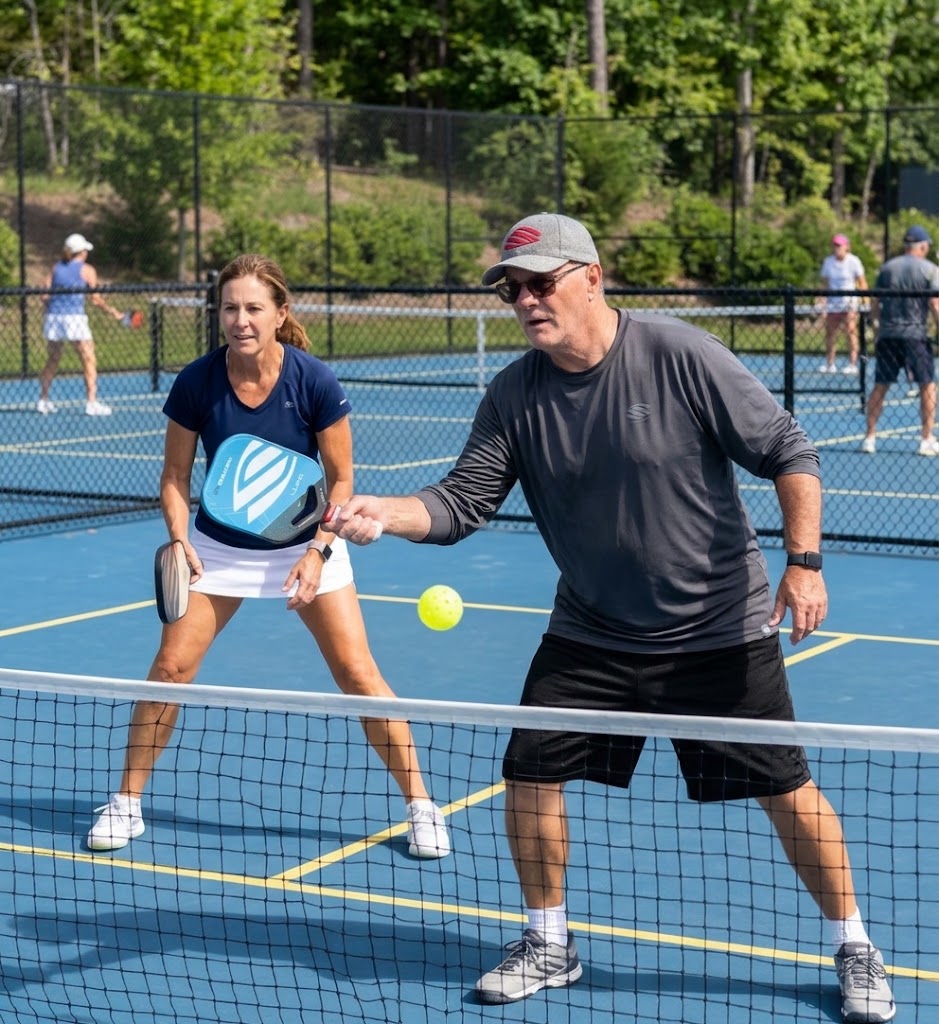
At the kitchen: play shoulder-to-shoulder spacing with your partner, paddles up, cover middle first, and reset anything that dips below net height.
Where Should I Stand When Serving And Returning?
Serving:
Server stands one to two feet behind the baseline, lined up slightly toward the center to protect middle on the next ball. After contact, recover into the court, but expect a deep return. Keep your partner near or on the baseline ready to handle that return with balance.
If you plan a third shot drop, pause at the transition zone several steps behind the kitchen. If the drop is good, both players close in together. If the third shot is a drive, your partner should be ready to absorb the next ball and help you finish your advance.
Returning:
Returner positions a half step behind the baseline to take high bounces in front. Aim your return deep crosscourt to the opponent’s backhand when possible. Hit, then go. Your goal is the kitchen line by the time the third shot crosses the net.
The returner’s partner should already be near the kitchen line, centered between sideline and middle. Watch the third shot to choose whether to pressure or prepare to reset. If the third is a quality drop, soften your hands and be ready to receive it with a calm block.
Non-Volley Zone: Owning The Kitchen Line Without Getting Burned
The kitchen line is the profit center of pickleball. Get there early, but arrive in control. When both you and your partner are set at the line, prioritize:
Middle first: that is where most high-percentage balls appear. Call “mine” early on attacks through the seam.
About the coach
RL
Russ Lombardo
Pickleball coach in Cary, NC
Helping new and experienced players learn and improve your game, focused on the Cary, NC area, including Durham, Raleigh, Apex, Morrisvillle
I help pickleball beginners build confidence and learn the game, while helping experienced players sharpen their skills, strategy, and consistency. Whether you're picking up a paddle for the first time or working toward a stronger all-around game, I create personalized lessons around your goals. In Cary, North Carolina, and nearby communities, I coach with a relaxed, welcoming approach that keeps learning productive and enjoyable. I am a PCI-certified Pickleball coach with five years of coaching experience. We can work on grips, serves, returns, dinks, court positioning, shot placement, resets, and handling different styles of play. Each lesson combines targeted drills with gameplay, so you can practice skills in action. As a Selkirk Advocate, I can provide paddles to demo and help you find a good fit. With a 5.0 rating from 113 reviews and 156 completed lessons, I would love to help you enjoy Pickleball and play with greater confidence. Book a lesson and let's get started.
Paddle up, elbows comfortably in, and contact in front. Think catch, not swat, when absorbing speed.
Dink patterns: make opponents move. Push wide, then test the middle. If they pop one up, attack to the body or the outside shoulder, then follow forward to close angles.
Common mistake: leaning into the kitchen with toes on the line and weight too far forward. If the ball dips, players get jammed. Keep your nose behind your toes, knees soft, and be ready to slide, not lunge.
The Transition Zone: How To Earn Your Way In
The strip between the baseline and kitchen is where rallies are won or lost. The keys:
Third shot decision: if opponents stay back or float a return, drive through the middle and follow your ball as a unit. If they are set at the line, a soft third that lands in the kitchen buys you time to come in.
Reset stance: when you are under pressure, widen your base, lower the paddle to net height, and block to the middle kitchen. Do not swing. Absorb and place.
Two-step advance: play a ball, close two controlled steps, then split step. Repeat until you reach the line together.
Stacking And Switching Made Simple
If you and your partner have preferred sides, stacking keeps strengths in position. The quick version:
Standard stack: both players start on the same side before serve or return. After contact, one slides across to end up on their preferred wing.
Signals: use a discrete hand behind your back or a simple verbal cue like “switch” or “stay.” Decide before the point.
On returns: place the ball deep, then execute your crossover early so you are not switching under pressure at the kitchen.
Doubles Communication Cues You Can Use
Good teams talk early and often. Borrow these phrases:
“Mine” or “yours” as the ball crosses the net, not after.
“Step” to remind your partner to close the line after a quality third or fifth shot.
“Two back” if both of you must reset from the transition zone.
“Middle” to attack the highest percentage seam.
“Up” after a good drop that earns you the line.
Make it friendly and consistent. My coaching style is relaxed and welcoming, and I bring that same energy to doubles communication so partners build camaraderie while tightening their shape.
Drills I Use To Build Court Awareness
Here are game-tested drills I run across Cary locations like Carpenter Park, Ed Yerha Park, and Taylor YMCA:
Return and Close: Returner hits crosscourt deep, then must touch a tape mark one step behind the kitchen before the third shot crosses the net. This reinforces timely advancement and arriving stable at the line.
Middle First Dink: Partners stand at the kitchen. Alternate three dinks to the opponent’s inside foot, then one to the sideline, repeat. Progression: add a controlled attack only on balls above net height. Focus: paddle up, compact swing, early decision.
Transition Reset Gauntlet: One player at the kitchen, one in the opposite side transition zone. Kitchen player feeds five fastballs to body or hip. Transition player blocks to the middle kitchen with quiet hands. Switch roles. The goal is to convert chaos into a neutral rally.
Stacking Walkthrough: Set cones on both sides to mark start positions for a stack. Serve or return, then execute the planned switch within two steps. Emphasize communication and footwork rather than speed.
Common Positioning Mistakes I See Locally, And Quick Fixes
Drifting back after the return: Fix it by committing to a destination, the kitchen line, and split stepping as the third shot crosses. Put a piece of tape on the court during practice as a visual target.
Chasing wide balls and opening the middle: If you move for a sideline dink, your partner closes the middle. Say “cover” as you go. Practice the seesaw shape so one closes middle while the other guards the line.
Over-attacking from the transition zone: If you are not fully set or the ball is below net height, reset. A calm block to the middle wins more rallies than a low-percentage swing.
Toes on the kitchen: Keep your heels light and weight centered so you can retreat that tiny half step on dips. Your contact point will improve immediately.
How To Adjust Positioning Against Bangers And Lobbers
Against bangers:
Soften your hands. Meet the ball early, short stroke, and block to the middle. If they camp at the baseline, make them hit a fifth or seventh by neutralizing pace.
Shrink the seams. Stand a half step closer to your partner at the kitchen to remove the high-percentage gap.
Mix depths on your dinks. A few deeper dinks to the feet will pull them off the line and reduce their leverage.
Against lobbers:
Call “switch” early on lobs over the middle. The partner with the easier angle takes it while the other fills the kitchen.
If they lob from below net height, step in and punish first. If they lob well, retreat in balance and reset the next ball to regain the line.
What Is The Best Way To Practice Pickleball Court Positioning In Cary?
Build small, daily reps into your schedule. At lunch or after work, bring a partner to Carpenter Park, run the Return and Close drill for 10 minutes, then play skinny singles down the line to force balanced movement. Film 5 minutes on your phone and watch your feet, not your swing. Ask: Was I set at contact, did we move together, and did we protect the middle first?
Who I Coach, Where We Meet, And How Pricing Works
I coach beginners through advanced rec players across the Cary area, always tailoring sessions to your goals. I teach at convenient local spots including Carpenter Park, Ed Yerha Park, McCrimmon Parkway Neighborhood Park, Taylor YMCA, and nearby Apex Nature Park and Morrisville Community Park.
Pricing is straightforward for 60-minute lessons:
Single lesson: about $60, pay as you go.
3-lesson pack: about $54 per lesson, ideal if you want quick momentum on positioning and shot selection.
5-lesson pack: about $51 per lesson, the best value for steady progress.
If you want to talk through your current level and goals first, I offer a free 30-minute Player Assessment over Microsoft Meet. We will discuss your objectives, challenges, and next steps.
My lessons combine targeted drills and live play so you leave with clear priorities. I keep sessions relaxed and welcoming, so you feel the excitement of the game while building real confidence.
FAQ
What do private pickleball lessons cost in the Cary, Durham, Raleigh, Apex, and Morrisville areas with Coach Russ?
Most students choose either a single 60-minute lesson at $60, a 3-lesson pack at $54 per lesson, or a 5-lesson pack at $51 per lesson. Packs are paid up front and you can book them on your schedule. I also offer a free 30-minute Player Assessment to plan your training.
Where do you coach court positioning sessions around Cary?
I coach at convenient local venues including Carpenter Park, Ed Yerha Park, McCrimmon Parkway Neighborhood Park, and Taylor YMCA in Cary. I also meet students at Apex Nature Park in Apex and Morrisville Community Park in Morrisville, as well as several locations in Durham and Raleigh.
Can you help tennis players in the Cary area adjust their positioning for pickleball?
Yes. We focus on arriving at the kitchen in balance, learning resets in the transition zone, and simplifying volleys with compact contact. You will keep your net instincts, but adapt them to pickleball’s shorter court and lower contact points.
Do you offer small-group lessons focused on doubles positioning around Cary?
Yes, I run small groups so partners can work on communication, stacking, and movement patterns together. We use targeted drills on court spacing and then apply them in live points to lock in the habits.
What should I bring to a positioning-focused lesson?
Wear comfortable athletic clothes, court or tennis shoes, and bring water. Bring your paddle if you have one, or I can provide a Selkirk demo so you can find a fit that supports your style.
If you are ready to move smarter and win more points, book a lesson. I will meet you on a local court, set clear goals, and help you enjoy every step of your progress.